Flexible access to offshore carbon storage
Carbon storage.
Beyond the pipeline.
A ship based pathway designed to collect captured CO₂ at source from dispersed industrial emitters and transport it directly to permanent offshore geological storage.
COLLECTSHIPINJECTSTORE
01 Beyond pipeline reach
02 Build volume incrementally
03 Terminal functions onboard
04 Direct offshore injection
The access gap
Storage access should not depend on being next to a pipeline.
Many industrial sites sit outside the first CO₂ pipeline clusters. storeCO2 is developing a flexible marine route intended to connect suitable emitters with qualified offshore storage sites.
One integrated service brings together conditioning, marine transport and offshore injection, reducing interfaces for the emitter while preserving optionality across ports and stores.

Flexible by DesignPort aligned and project specific, with only the shore infrastructure each route requires.
Beyond the pipeline
Start with today’s volumes. Scale as the network grows.
Pipeline-led networks often need significant committed volume before they can proceed. The LTIV® solution is designed to create another route: aggregate CO₂ from multiple emitters, begin with the volumes available and add capacity as more projects become ready.
Integrate terminal functions with the vessel. The storeCO2 LTIV® is designed to bring aggregation, refrigeration, buffer storage, transport and offshore injection together onboard one modular, flexible and mobile asset. The aim is to simplify the logistics chain and reduce the scope of onshore CO₂ handling facilities.
01Minimal shore infrastructure
Replace a large fixed onshore aggregation, conditioning and buffer storage terminal with vessel based processing and storage, leaving each emitter with only the project specific capture and transfer interface it requires.
Multiple ways to collect
Designed to load liquid CO₂ from tank containers and rail cars, while also accepting gaseous CO₂ for onboard conditioning and refrigeration.
Batch or continuous operation
Supports intermittent batch collection or continuous CO₂ transfer and disposal, matched to the emitter, port and storage system.
Build volume incrementally
Combine supply from several emitters and grow throughput in phases, helping credible early projects progress without waiting for every future volume to be committed.
One connected service
From captured CO₂ to permanent storage.
One accountable pathway across the interfaces that otherwise slow projects down.
01Collect
Receive captured CO₂ through the transfer arrangement suited to each emitter.
02Ship
Aggregate and transport CO₂ by a purpose configured ship.
03Inject
Condition and deliver CO₂ into an approved offshore storage well.
04Store
Permanent geological storage under the operator’s monitoring regime.
The LTIV® solution
One ship.
Multiple functions.
The LTIV® solution combines established marine and process systems within a protected ship architecture.
- Onboard CO₂ conditioning and refrigeration
- Insulated liquid CO₂ storage
- Offshore pressure conditioning and injection
- Closed system approach intended to minimise operational emissions
Patent family includes granted US patents and a pending UK application. Project performance remains subject to engineering, class, permitting and storage site qualification.
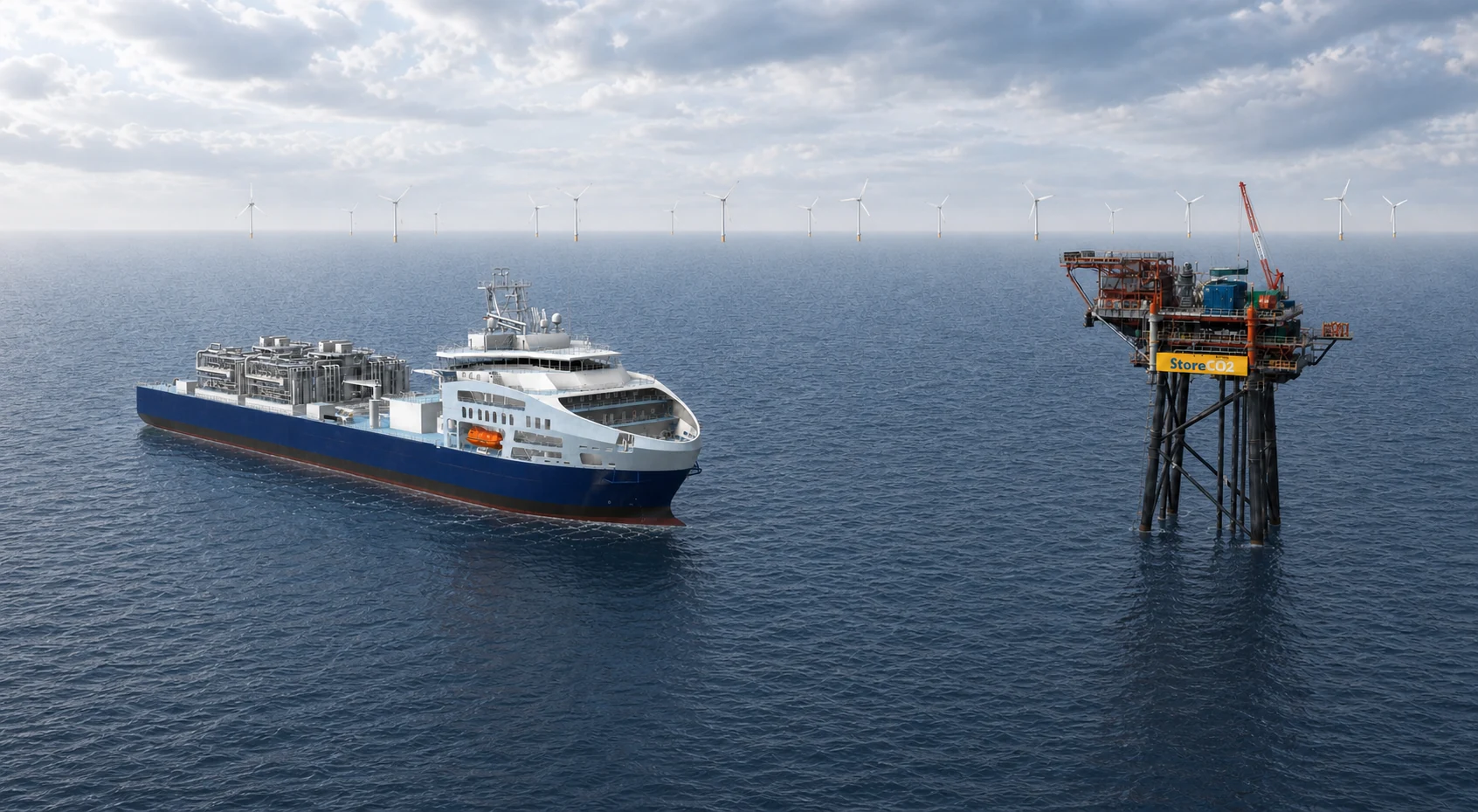
Flexible by DesignShip-based emitter-to-store routing has been demonstrated without the need for a new offshore subsea pipeline
Where storeCO2 can add value
Built for the emitters the first networks may not reach.
Dispersed emitters
A flexible route for emitters beyond practical pipeline reach, using gaseous or liquid CO₂ transfer options matched to the site and available logistics.
Phased projects
A marine route that can support staged volumes and evolve as capture and storage capacity develops.
Multiple stores
Potential routing optionality, subject to compatible specifications, commercial access and regulatory approvals.
From concept to service
A disciplined project pathway
Credible carbon storage begins with the right emitter, port and store, not with the ship alone.
- ScreenCO₂ volume, purity, capture readiness, port access and timing.
- MatchCompatible storage specification, injection profile and commercial window.
- EngineerDefine the complete chain, interfaces, ship basis and permitting plan.
- DeliverProgress through FEED, agreements, approvals, financing and execution.
The commercial purpose
“The opportunity is not simply to move CO₂. It is to make permanent storage commercially accessible to more emitters.”
storeCO2 UK Limited
